[UPDATE] An Open Letter from Resonance Ensemble and Members of the Portland Arts Community

June 9, 2020
On May 25, 2020, George Floyd, a 46-year-old black man, died handcuffed behind his back on a Minneapolis, Minnesota street, while white police officer Derek Chauvin knelt on his neck for almost nine minutes and three other officers watched. Local arts organization Resonance Ensemble immediately drafted an open letter in response to the devastating news, demanding that the state of Oregon and our leaders take action. Resonance invited arts leaders and citizens of our state to join us in stating unequivocally that BLACK LIVES MATTER and demanding that Oregon do better to protect the lives of our black citizens. The original plan was to deliver the letter to Governor Brown and Mayor Wheeler after a week of receiving signatures.
Resonance Ensemble’s original open letter garnered over 1,000 signatures representing the Portland arts community, citizens, major arts leaders, and organizations who all stand together in support of tangible change to protect the lives of black people.
Since that time, there have been some changes:
Governor Brown has taken bold steps to acknowledge where the state has failed black people, has met with local leaders of color, and announced actionable steps the state of Oregon can take to do better. Governor Brown has stated, “We must do what we can right here in Oregon.” and “Words are not enough, we need action.” and finally, “Join me in co-creating a more just Oregon where black Oregonians can thrive.”
Mayor Wheeler has removed police officers from the Portland Public Schools and has signed the Mayor’s Pledge, President Obama’s call for mayors, city councils, and police oversight bodies to address police use of force policies. He has also met with local leaders of color and announced actionable steps the city of Portland can take.
Because of these recent changes, we have updated our letter (June 9, 2020) to clarify the accountability the arts community still demands of our state and local government officials.
#REQUIEMSTORIES: "The music is alive and is already changing us."
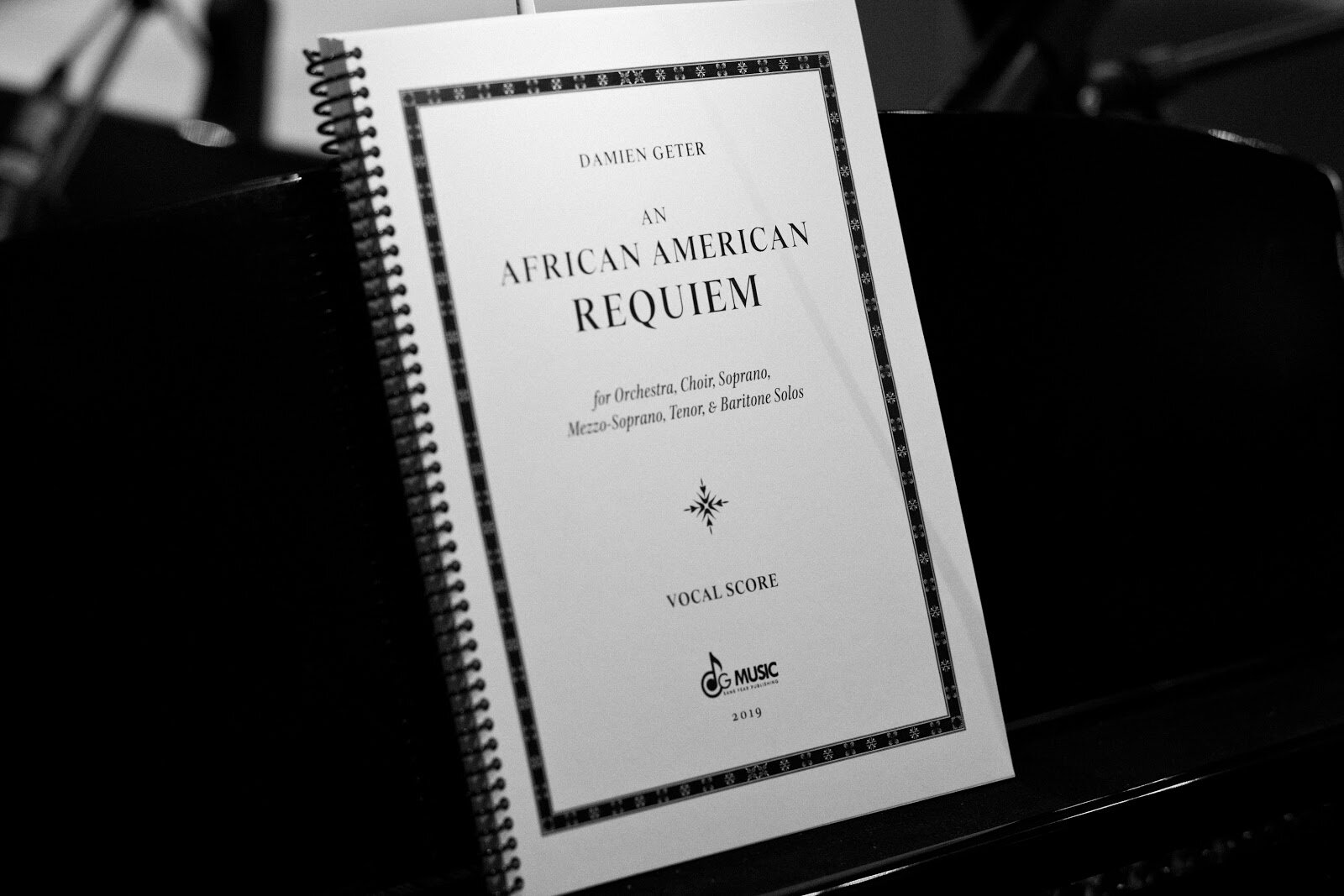
May 23, 2020. Today is the day ‘An African American Requiem’ was supposed to premiere at the Arlene Schnitzer Concert Hall, with full orchestra, 4 world-class soloists, and a choir of over 100 singers.
We are asking everyone to submit what we are calling #requiemstories. Each day we receive another one - it has filled our hearts to read other’s experiences of this unfortunate delay. We will continue to post these stories as we get them. To submit your requiem story, please email us at info@resonancechoral.org.
Thank you to all who are with us on this journey. We stay hopeful and send you love.

Katherine FitzGibbon’s #requiemstory
In an "alternate universe," today would have been the world premiere of Damien Geter's groundbreaking work, An African American Requiem. Damien's work is a powerful tribute to victims of racial violence against African Americans, from lynchings to police brutality. We need this work. We needed it when Damien wrote it, and sadly, we still need it. Ahmaud Arbery. Brionna Taylor.
When we see injustice in the world, we speak out against it. As a musician, the way I process things and the "pulpit" I can use is musical performance. I've struggled these last two months with my feelings of loss — while recognizing that many other people have experienced loss on a vastly more significant scale than my own. But there is still loss; I have been part of the team of people bringing this work to life, raising funds, building awareness, for the last few years. I had conducted several choir rehearsals before we had to disband due to COVID. I "met" this work, movement by movement, as Damien was writing it, and I saw over and over how its very existence was galvanizing our community.
There is a lot we have lost by not performing this work today. (And we are comforted by the knowledge that we WILL perform this work in the future — hopefully in January of 2021!) We've lost, for now, our opportunity to use Damien's extraordinary music to respond NOW to racial violence against African Americans. We've lost, for now, the intentional community of choral singers that has come together, from all races and ethnicities, for what felt to us like a higher purpose. We've lost, for now, the incredible energy from our community partners on the African American Requiem Advisory Board who were working to create an entire curriculum around this concert, to build momentum in young people and Black Student Unions around the region, and (as Ombrea Moore at SEI said), to create Wakanda in the Arlene Schnitzer Concert Hall.
But today is also a celebration. This music exists, and our hundred and ten voice choir has these amazing musical scores in our homes. We are still ready. The music is alive and is already changing us. We just have to wait a little longer for it to change our audience.
One of my friends was reflecting this week about the way we can choose to identify and amplify the good things, the beautiful, the positive even against a backdrop of anxiety or loss. She asked, what is this? Is it grace? Is it hope? It's not just keeping a positive attitude about what may come, but it's choosing to see the beautiful things NOW.
So, today, on what would have been the world premiere of An African American Requiem, I choose to see and embrace these truths. Damien has composed a work that is already doing what he set out to do. It is changing us. We have created a choir that never existed before, and we are brought together by our shared passion for this music and this message. We are forming new friendships. We are doubling down on our commitment against injustice. And we sense this shared energy and support from everyone who would have been in the audience tonight, and from our friends at the Oregon Symphony and AllClassical Portland. Can this seed of beauty and grace that already exists sustain us through our difficult time until it reaches its full flowering at its later world premiere? I know it can.
—Katherine FitzGibbon, Artistic Director, Resonance Ensemble
Happy #GivingTuesdayNow, All.
We need each other every day of the week.
When the Giving Tuesday organization reached out to us to join them in this campaign we were hesitant to commit. At a time when so many are struggling to make ends meet, and arts organizations everyone need support, what is the right way to ask for support?

We need each other every day of the week.
When the Giving Tuesday organization reached out to us to join them in today's giving campaign, we were hesitant to commit. So many are struggling to make ends meet, and arts organizations everywhere need support.
But we realized this pandemic affects people's livelihood and it affects organizations we care about — our community partners and our arts colleagues. #GivingTuesdayNow is an opportunity for people around the world to stand together in unity — to use their individual power of generosity to remain connected. We love that idea.
Would you consider giving today to organizations you support, including Resonance Ensemble? Your gift to Resonance supports paying fees to our artists *this month*, to replace income they are losing from postponed performances. Your gift funds exciting commissions of new and timely music that are already in the works for every concert next season. And your gift ensures that Resonance's mission continues to thrive through this difficult time, so that we can keep giving back to you and our community with relevant art that matters.
On this day, we ask you show your generosity however you are able. Whether it's by helping your older neighbor get groceries, advocating for a local artist you love, sharing a skill, or giving to your favorite arts organization, every single act of generosity counts right now. You have gifts to give and the world needs you.
Happy Giving Tuesday, all. (...and happy giving Wednesday, Thursday, Friday, Saturday, Sunday and Monday, too.) We appreciate you every day of the week.
With love,
From all of us at Resonance Ensemble
An African American Requiem Postponed Until 2021

Dear Resonance Supporters,
Resonance has been closely monitoring the COVID-19 research in order to ensure the health and safety of our audiences, artists, and community. We have made the hard decision, along with our partners at the Oregon Symphony and AllClassical, to postpone the African American Requiem world premiere until next season. The concert has now been rescheduled for Friday, January 22, 2021.
The Resonance team will continue to update you as we plan for this and other exciting events next season. In the meantime, if you purchased your AAR tickets through Resonance Ensemble, the following options are available for you:
Your ticket can be converted automatically to a ticket for the same seat(s), for the Friday, January 22nd performance at the Arlene Schnitzer Concert Hall. (This is the default option; we hope you’ll be able to come to the rescheduled date!)
You can donate your ticket’s value back to Resonance (a tax receipt will be issued to you).
You can request a refund.
Please let us know your preference by May 1st by emailing us directly at info@resonancechoral.org. If we do not hear from you by then, your ticket(s) will be converted to a ticket for the same seat for the Friday, January 22nd date.
If you ordered your tickets through the Oregon Symphony website, the Oregon Symphony will be in touch with you today with similar information.
Resonance cares. Mindful of the human and financial toll of this pandemic, we have committed to paying our artists a portion of their fees for this May’s concert. Donating right now, no matter how small, will help us support our musicians who find themselves suddenly without income.
To support this initiative, please click here. We appreciate your generosity.
We have hope that things will continue to improve. We’re putting the finishing touches on our upcoming season and look forward to the time when we will again share a space together in celebration of new music that promotes meaningful social change. Stay tuned for our 2020-21 season announcement!
Our hearts continue to go out to all those in our own community and around the world who are being impacted by this epidemic.
Thank you for supporting Resonance Ensemble.
Kathy FitzGibbon
Artistic Director, Resonance Ensemble

Your belief and support are needed now more than ever.

Dear Resonance Supporters and Friends:
In the wake of the growing COVID-19 / coronavirus pandemic, I wanted to take a few moments to check in with you.
Resonance Ensemble is committed to walking our talk around social awareness. This is a challenging time for everyone. We are thinking particularly of individual artists and of arts organizations who are having to cancel events. This affects people’s livelihood and the sustainability of arts organizations. Your belief and support are needed now more than ever in our arts community.
We have learned the importance of social distancing to slow the spread of COVID-19, to allow our health care system to have the capacity to treat all of those who need it. We will be rehearsing our African American Requiem choir remotely for the near future and will continue to make decisions with our artists at the front of mind. We are grateful to all of you for doing what you can to work from home when possible, and to help those who do not have that flexibility.
For the latest information regarding the virus, please visit the the Multnomah Health Department website and The World Health Organization website.
Stay safe, keep yourself educated, and support your favorite arts organizations and individual artists when and how you can. Thank you for all you do as part of the Resonance community. We hope to see you at An African American Requiem in May.
Katherine FitzGibbon
Board President and Artistic Director
Resonance Ensemble

COMPOSER SPOTLIGHT: Joe Kye
All my life I’ve listened.
As an infant, I rode on my mother’s back, my ear pressed between her shoulder blades, the muffled hum of her lullaby enveloping me as I drifted off to sleep.
Over the next few weeks, Resonance features composers and artists whose work will be performed at the Safe Harbor concert on March 1st.
We continue with celebrated Portland-based performer, violinist/looper, and composer Joe Kye. Resonance Ensemble will unveil Kye’s newly-commissioned work, integrating folk music from Kye’s native Korea with American folk music and improvisation.
“My new work will have its world premiere on March 1st with my favorite Portland choir, Resonance Ensemble at Alberta Rose Theatre. Korean lullabies, folk rhythms with percussionist Darian Anthony Patrick, and uplifting choral harmonies...DON’T MISS THIS SHOW. I’m very proud of this piece, and I can’t wait to share it with you.”
Joe Kye’s new music video premieres on PopMatters today! “It's the American dream as it should be, Kye reaching across the divide with music to try and heal it - for everyone.” Take a watch:

Photo: Jason Sinn Photography
All my life I’ve listened.
As an infant, I rode on my mother’s back, my ear pressed between her shoulder blades, the muffled hum of her lullaby enveloping me as I drifted off to sleep.
At age six, I first heard the guttural sounds of English and recoiled at its harsh “s” and t” sounds, uncommon in the Korean language. These tall, white Americans sounded like spitting snakes.
In third grade, I remember my parents murmuring in hushed tones, wondering how they’d afford next month’s rent. In just two years in the United States, we’d whittled through our savings, the American Dream unveiling itself as but a tantalizing mirage.
And before I left for college, I listened as my parents sat me down to apologize, wiping away tears for all they were unable to provide, the grief and regrets of first-generation immigrant parents poured out onto our dining room table.
It wasn’t until I’d graduated, four years into teaching high school English in Seattle, that I finally began to listen to myself. From lullabies to Sibelius, Korean sitcoms to Stevie Wonder, I’d lived my life in the margins, absorbing the eclectic, unsure of my place in the world. But as I watched my students dream, grow, and find their place, I realized I’d never given myself the opportunity to pursue the one thing that afforded me true joy: music.
And so I left—a stable career, security and stability in the rearview, to synthesize and embark on a quest to give voice to my world, my identity.
This past summer, when Resonance Ensemble approached me about composing for Safe Harbor, I was overjoyed. How could I write a collaborative piece that gave voice—quite literally, in this case—to the anxieties of little Joe? The regrets of mama and papa Kye? How could I recognize these disquiets while also reassuring listeners that there is a different way? That we, with our individual hopes and dreams, can come together to build a community that allows each to express and pursue these fully, regardless of race, gender, class, or sexual orientation?
This very moment, our country continues to rip children away from their mothers. Our country continues to incarcerate fathers and brothers for the purpose of profit. Our country continues to justify the sins of the violent and powerful, choosing instead to blame victims for their suffering.
And so, in the face of these oppressions, I offer my voice—this collaborative performance with Resonance. I offer a meditation of empowerment, a dwelling place for the rekindling of compassion, a sonic clearing in which we can feel, together, what the alternative looks like.
Mark your calendars, friends. March 1st. Join us—all of us.
WE NEED YOU. Resonance Ensemble is able to commission artists like Joe Kye because of the generous support from listeners like you. Please consider donating to the Dinah Dodds Fund for the Creation of New Art today.

WHO IS JOE KYE?
Born in Korea and raised in Seattle, violinist- looper and vocalist Joe Kye has drawn rave reviews since launching his career, “discharging world[s] of emotion” and delivering “divine messages” with his lush string loops and eclectic style (Guitar World). Drawing upon his migrant upbringing, Kye blends indie-rock, jazz, classical, and pop to create a unique sound that “leaves everyone in awe” (Sac News and Review). With his innovative use of digital effects and looping, Kye weaves together diverse textures, catchy melodies, and rich, sweet vocals to create songs that groove, uplift, and empower listeners: "A single violinist...one mesmerizing symphony" (Sacramento Bee). A powerful storyteller with an inclusive sense of humor, Joe’s performances weave his immigrant narrative through his show, inspiring audiences to compassion and empathy in these divisive times.
For more information about Joe Kye, CLICK HERE
For more information about Darian Anthony Patrick CLICK HERE
COMPOSER SPOTLIGHT: Sydney Guillaume | Réfugié, mon Frère
Over the next few weeks, Resonance features composers and artists whose work will be performed at the Safe Harbor concert on March 1st.
We continue with Haitian-American composer Sydney Guillaume. His moving work, “Réfugié, mon frère,” is a setting of text by his father, Gabriel T. Guillaume, and reminds us of the humanity of refugees that is often overlooked.
“We are all travelers on the roads of the earth.
May I dare ask you not to forget
The humanity you carry within you.
My brother, whatever your refuge is, you are at home.”

Composer Sydney Guillaume
About “Réfugié, mon Frère”
“Réfugié, mon Frère” was written in 2017 at a time when DACA (Deferred Action for Childhood Arrivals) was being debated in the United States because of a suggested end to the program that granted temporary protection from deportation to nearly 700,000 young people. As an immigrant from Haiti who migrated to the U.S. with my family at 11 years-old, I was deeply affected by the uncertain future the “DREAMers” were facing through no fault of their own.
Since the premiere of the piece in 2018, there have been some gruesome acts against immigrants and refugees, including children being separated from their parents at the U.S. border. My hope is that this piece brings to focus a part of the immigration debate that is often forgotten – the humanity of the refugees fleeing their countries.
— Sydney Guillaume
Join us on March 1 to hear Resonance perform Guillaume’s “Réfugié, mon Frère.”
Sydney Guillaume will be attending Safe Harbor, and will participate in a Q&A talkback after the concert- so think of your questions!
Until then, please enjoy our friends at Lewis & Clark College performing “Réfugié, mon Frère” last winter:
About Sydney Guillaume
Praised by the Miami Herald for their “impressive maturity and striking melodic distinction”, Sydney Guillaume’s compositions are known to be intricate, challenging and yet highly spirited. They promote human values and are full of heart and passion. His compositions continually enthrall choirs everywhere and have been performed around the world. They have been featured at numerous conferences and international festivals like the American Choral Directors Association (ACDA), the World Choir Games and Ireland’s Cork International Choral Festival. He is an active member of the choral community as a composer, singer, clinician and conductor. In 2017, he was honored by the top music school in Haiti for his “great contribution in the expansion and the promotion of the music and culture of Haiti around the world.”
Sydney Guillaume graduated from the University of Miami in 2004 where his works were performed by the Miami University Chorale conducted by Dr. Jo-Michael Scheibe. Originally from Port-au-Prince, Haiti, he is currently residing in Portland, Oregon working as a full-time composer, conductor and clinician. For more about Mr. Guillaume, click here.
For more information about Safe Harbor click here.
COMPOSER SPOTLIGHT: Theresa Koon | Mother of Exiles: The Genesis
Over the next few weeks, Resonance features composers and artists whose work will be performed at the Safe Harbor concert on March 1st.
We begin with Portland composer Theresa Koon. Koon’s work, “Mother of Exiles,” is a musical adaptation and reimagining of Emma Lazarus’s famous poem, ("Give me your tired, your poor...). Resonance is honored to feature the world premiere and we thank Theresa Koon for taking the time to share some of her thoughts here today.
“Since I don’t have the temperament or money for political campaigning, music is the vessel I can offer to give voice to the thoughts and feelings of people who have no voice in the world. ”

Composer Theresa Koon
The genesis for the creation of Mother of Exiles arose during a talk-back session in 2018 with Director Katherine FitzGibbon of the Resonance Ensemble, and Jan Elfers, who heads the Ecumenical Ministries of Oregon. Resonance had just performed my Sufi cycle WHERE EVERYTHING IS MUSIC, and the tenor of our conversation with the audience centered around compassion, inclusivity and cooperation between people of differing faiths and backgrounds. An audience member inquired about my upcoming composing projects, and out of my mouth popped a plan to set Emma Lazarus’s famous poem “The New Colossus,” which is inscribed on the Statue of Liberty. Until that moment, this intention had barely registered itself in my mind. Kathy immediately asked if Resonance could perform it, which was an honor I accepted with delight.
Lady Liberty and Lazarus’s poem have been in the news a lot during the past year, including various reinterpretations of their significance. Here are a few details from my research:
After the Civil War, France gave the Statue of Liberty to the United States to commemorate the ending of slavery here, and to recognize the U.S. in finally becoming a “true democracy.” Soon after the Statue arrived, Emma Lazarus wrote her poem to express gratitude on behalf of her Jewish ancestors who had emigrated from Russia to the US during the pogroms. When poem was inscribed on the Statue in New York Harbor after Lazarus’s death, both Lady Liberty and “The New Colossus” combined to represent the face and voice of U.S. democracy, of freedom from slavery, and also as a welcome to desperate people in need of asylum. I believe the majority of Americans, despite our differences, still view the Statue of Liberty and her torch in this light, since most of us have ancestors who emigrated from somewhere else.
We are living at a time when immigration is a world-wide issue, which no one country can solve alone. To me, this is a delicate and complex situation that deserves compassionate consideration and collaboration. Since I don’t have the temperament or money for political campaigning, music is the vessel I can offer to give voice to the thoughts and feelings of people who have no voice in the world.
In working with the public domain text, I chose to set eleven of the fourteen lines in Lazarus’s sonnet, which include those that are best-known. At the point when the text refers to the Statue as “Mother of Exiles”, I began overlapping translations of that name in sixteen different languages, and also adopted it as the title of my choral version.
My dream is for Mother of Exiles to be performed by choirs around the world, with hopes that it will become an anthem for campaigns and organizations who believe in its purpose.
You can find out more about this project here:
For more information about Safe Harbor click here.
An African American Requiem to be broadcast live coast-to-coast!

President and CEO of All Classical Portland, Suzanne Nance
Great news! All Classical Portland will produce an unprecedented live, bi-coastal broadcast in collaboration with New York’s WQXR of the world premiere performance of Damien Geter’s An African American Requiem. With the goal of providing greater access to and amplification of this important work, following the performance and live simulcast on May 23rd, these partner radio stations will distribute a free program featuring the premiere, as presented by Resonance Ensemble and Oregon Symphony, to radio stations nationwide. Broadcast info: www.allclassical.org
Resonance is thrilled about the news that the world premiere of our commission of Damien Geter’s An African American Requiem has been picked up for a live coast-to-coast radio broadcast. This groundbreaking concert (May 23rd, 2020) with our partners at the Oregon Symphony will be broadcast live locally by All Classical Portland and nationally by WQXR New York, who will share it with more than 200 cities in their syndication.
Artistic Director Katherine FitzGibbon recalls, “All Classical CEO Suzanne Nance was excited about the opportunity to partner on a local live radio broadcast. After we met with Suzanne and Steve Wenig of the Oregon Symphony, Suzanne reached out to her contacts nationally and developed this vision of a live coast-to-coast broadcast. We are so grateful to her and to All Classical for championing this work.”
Concert attendees will need to make sure to update their calendars to the new 6:00 pm start time, so that our East Coast listeners can tune in as well. All of the other details will be the same -- the same amazing cast and powerful music -- and now, audience members in Portland will be able to be part of history, along with listeners across the country, in this groundbreaking world premiere.
Deepening Relationships with Visionary Composer Melissa Dunphy
“I feel, on a deeper level, as though this is part of what Resonance can do. We can help bring innovative new choral works to life, works that can shine a light on some of the most challenging issues our society faces today. We can promote existing works that haven’t yet found a wide audience. And we can partner closely with visionary composers like the amazing Melissa Dunphy, who I am now grateful to call my friend.”

Artistic Director Katherine FitzGibbon with composer Melissa Dunphy
About two years ago, I was finalizing repertoire for our 2017-18 season's concerts. Resonance singer Christine Johnson reached out to me and said that she knew an amazing piece I should consider for our BODIES concert collaboration with Pride Northwest. It was called "What Do You Think I Fought for at Omaha Beach?", and it was by a composer whose work I didn't yet know, Melissa Dunphy. Christine had performed it with her previous choir, the St. Louis Chamber Chorus, and Melissa Dunphy had been their composer in residence.
I was blown away by this piece. It set the Maine Senate testimony of an unassuming elderly WWII veteran, Phillip Spooner, who was asked whether he believed in equal rights for gay and lesbian people. He asked, "What do you think I fought for at Omaha Beach?" and explained that he fought for equality, not so that his gay son would have fewer rights than his other sons. I found the text extraordinarily moving, but I also felt like the composer had created a special kind of musical magic. The music created a sense of dramatic arc, with intense ebbs and flows that highlighted the emotion behind the text. And it was so beautifully written for the voice. "Who is this composer?," I thought.
So, as one does in the modern age, I did a deep dive into Google and found all of Melissa's works on her website. She has composed a treasure trove of exquisite choral music with texts that engage deeply with some of the most challenging social and political issues of our time. I programmed Melissa's multi-movement American DREAMers on the next season, for the fall of 2018.
Fast-forward to the fall of 2018, when the fall season began accompanied by the heartbreaking and courageous Senate testimony of Christine Blasey Ford in the Brett Kavanaugh Supreme Court hearings. For me, and for many women I know, one of the most frustrating aspects of the hearings was hearing how Dr. Ford was personally attacked, and learning that she and her family had been threatened, for telling her story. I stomped around feeling helpless until I realized what I could do, in my own sphere -- I could amplify this story by commissioning it to be set to music. And I could pair it with the unfortunately parallel testimony of Anita Hill, two and a half decades earlier. Conveniently, Resonance had already programmed a concert with our female singers called Women Singing Women for February of 2019.
By now you must see where this is going (and maybe you have heard this amazing work!) -- I reached out to Melissa, knowing her to be the ideal composer for this project, and asked whether there was any chance she'd have time to compose something by January 2019 (just three months away at that point! Not the ideal turnaround time....) She immediately said yes, having had a similar experience watching Dr. Ford's testimony.
Melissa's work LISTEN was phenomenal, and our performances sold out. Audiences didn't just shed gentle tears, but they sobbed audibly. It provided a kind of collective catharsis that many of us needed.
Yesterday, I had the opportunity to give a joint presentation at the National Collegiate Choral Organization conference with Melissa. I proposed this session, on the Innovation and Social Conscience in the Music of Melissa Dunphy, because I believe conductors NEED to know her work. The session was a blast -- like getting to sit up in front of conductors I know and love, with a composer I know and love, and talking about music and issues that are deeply important and personal to me. (Also, if you haven't heard Melissa speak before, she is brilliant and funny and wise, and I would delightedly shoot the breeze with her for hours!) And afterwards, many conductors came up to me and thanked me for bringing Melissa's work to their attention.
I feel, on a deeper level, as though this is part of what Resonance can do. We can help bring innovative new choral works to life, works that can shine a light on some of the most challenging issues our society faces today. We can promote existing works that haven't yet found a wide audience. And we can partner closely with visionary composers like the amazing Melissa Dunphy, who I am now grateful to call my friend.